
FAQs
Frequently Asked Questions
-
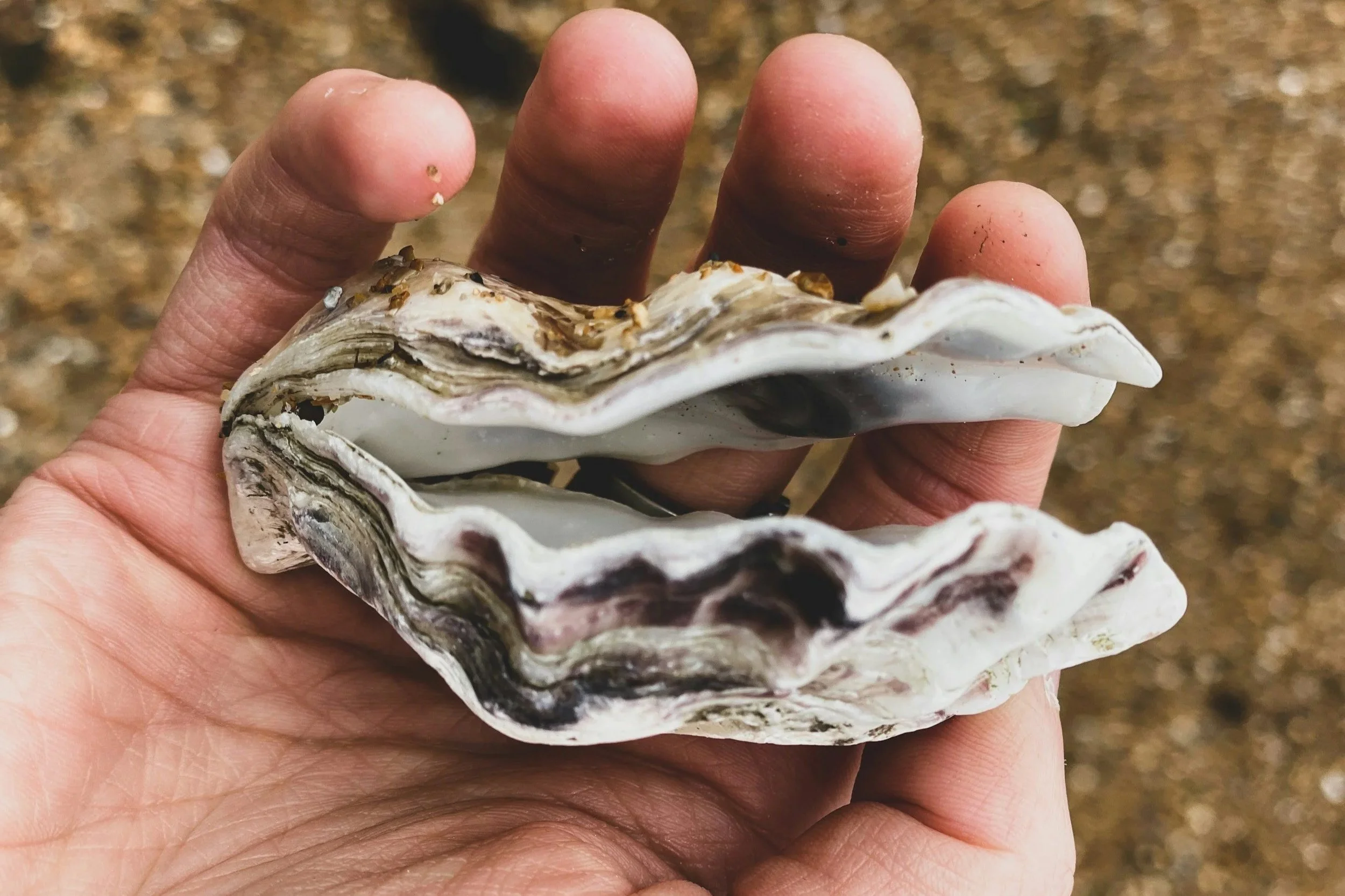
Our oyster larvae are grown in a lab. Once they reach a certain size, they are exposed to oyster shells where some permanently attach to the host shell and begin to grow, at which point they are “spat-on-shell”. The number of spat that attach will vary, but usually range from 10 to 20.
-
Every donation directly supports oyster restoration in the Wye River.
A $100 donation helps plant more than 30,000 oysters, with the potential to filter approximately 60,000 gallons of water per day at maturity.
A $1,000 donation helps plant more than 300,000 oysters, with the potential to filter approximately 600,000 gallons of water per day at maturity.
How are these estimates calculated?
Our estimates assume a 10% survival rate from spat on shell to maturity, with each surviving adult oyster filtering approximately 20 gallons of water per day.
These figures represent estimated potential filtration capacity as actual results vary depending on oyster survival, growth, and environmental conditions.
-
In 2025, our “Founding Funders” were friends and neighbors who came together to help us launch the program. We raised enough in individual donations to purchase and plant one barge of oyster SOS. In 2026 we were able to fund 3 barges, each containing over 20M SOS. Two barges were funded by community members and one funded largely from support from Queen Anne’s County. For 2027 and 2028, we have been awarded a grant from the National Fish and Wildlife Foundation that will not only fund one barge of SOS in each year but will support our development of a reef monitoring program. We will continue to seek grant support from additional sources, with a portion of that funding dedicated to capacity building for our program, primarily focused on improving our ability to perform reef assessments and communicate results. Our goal is for donations from the community to grow to fund planting of 3 barges in 2027. Community Support is critical to attracting grant funding, as most of our grantors prioritize support of Community-driven programs, requiring significant matching funds from the community. By leveraging community funding through grants, your individual donation is worth more and accelerates the restoration timeline.
-
Given the vast size of the Wye River Oyster sanctuary, 3510 acres of which 1,100 is historic oyster bottom (23 historic bars), we expect it may be 8 to 10 years before we can declare victory and call the Wye Sanctuary’s oyster beds fully restored. With your help and continued efforts by organizations including the MD DNR, Chesapeake Bay Foundation, Oyster Recovery Partnership and others, we believe that through existing reefs, new plantings, and natural recruitment (reproduction), full restoration is possible within this time frame (see definition outlined by the Oyster Metrics Workgroup). In the near term, we will focus on improvements in the health of each oyster reef we plant and measures of water quality.
-
Yes. WROP is committed to monitoring its restoration efforts through both pre-planting and post-planting assessments.
Pre-planting monitoring establishes baseline conditions, while post-planting monitoring evaluates oyster survival, growth, population density, and overall reef health.
Working with experienced restoration partners, WROP will use these findings to measure restoration success and guide future planting efforts.
-
Both the Maryland DNR and local environmental nonprofits have oyster restoration efforts underway. These efforts are part of Chesapeake Bay-wide initiatives. The Wye River has benefitted from significant oyster plantings by the DNR and Oyster Recovery Partnership but there its no guarantee that the Wye will get attention on an annual basis.
For now, the DNR has funding through 2027 for oyster restoration within the Eastern Bay complex, of which the Wye is a part. Our goal is to shorten the timetable for restoration by accelerating large-scale SOS plantings in The Wye.
-
The oyster SOS will be planted on previously mapped locations on historical oyster bars, located within the Wye oyster sanctuary. Specific locations will be coordinated annually with the DNR.
-
We partnered with Seed-to-Shuck Ventures to supply our spat on shell. Since 2022, Seed to Shuck has produced over 2 billion spat on shell, and they apply proven, in-house production methods to grow SOS for us as well as for the Maryland DNR.
-
The ultimate measures of impact are improvements in water quality. It will take years of plantings to restore water quality, but our goal is to see measurable improvements in the next 5 years. In the interim, we will focus on our impact on the reefs themselves -- increasing their size, density, and overall health. The Harris Creek oyster sanctuary saw significant oyster restoration efforts between 2011 and 2020. Today Harris Creek has consistently the highest grades on water quality. We hope to achieve similar results.
-
The Wye River Oyster Program is a volunteer community-based initiative, so the best way to help is to become engaged and a part of our restoration efforts. Contact us to discuss the various ways to become involved and of assistance. Click on the Support the Effort button on the top of the page for contact information.
Additional details:
-
The impact of oyster restoration efforts can be seen in various timeframes.. The first signs of water quality improvement might begin showing within a few years, but substantial and sustained impacts will likely take 5–10 years to fully manifest.
Short-Term (1–3 years):
○ Oyster survival and establishment: Early restoration efforts primarily focus on the survival and growth of oysters. It takes time for oysters to establish themselves in a new environment and reach a size that is capable of filtering water effectively. During this time, the oysters are still maturing, and water filtration rates may be modest.
○ Initial benefits: Some initial improvements in water quality may be noticed, but these are often small and localized.
○ An oyster spat could filter about 1 to 2 gallons per day in their first year, depending on environmental conditions and their growth rate. In Year 2 and Year 3, oyster spat undergo significant growth, and their filtration capacity increases dramatically.
In Year 2, an oyster might filter approximately 5 to 10 gallons of water per day. By Year 3, oysters are nearing full maturity and can filter up to 20-25 gallons per day.2. Medium-Term (3–5 years):
○ Filtration and habitat development: As oysters mature, their filtration capacity increases, leading to improvements in water clarity and overall water quality. Oyster reefs also begin to provide habitat for other marine species, increasing biodiversity in the area.
○ Increased nutrient removal: Oysters start to contribute more significantly to nutrient cycling, helping to reduce excess nutrients (like nitrogen and phosphorus) in the water, which can alleviate eutrophication issues.
3. Long-Term (5+ years):
○ Ecosystem-level impact: As oyster populations grow and reefs become more robust, their impacts on water quality, biodiversity, and the overall health of the ecosystem become more significant. The effects are often seen on a larger, regional scale, particularly in terms of improved water clarity, reduced algal blooms, and healthier fish populations.
○ Sustainability and resilience: A fully restored oyster reef can act as a critical part of the ecosystem, helping to buffer the effects of storms and improve the resilience of the habitat over time.